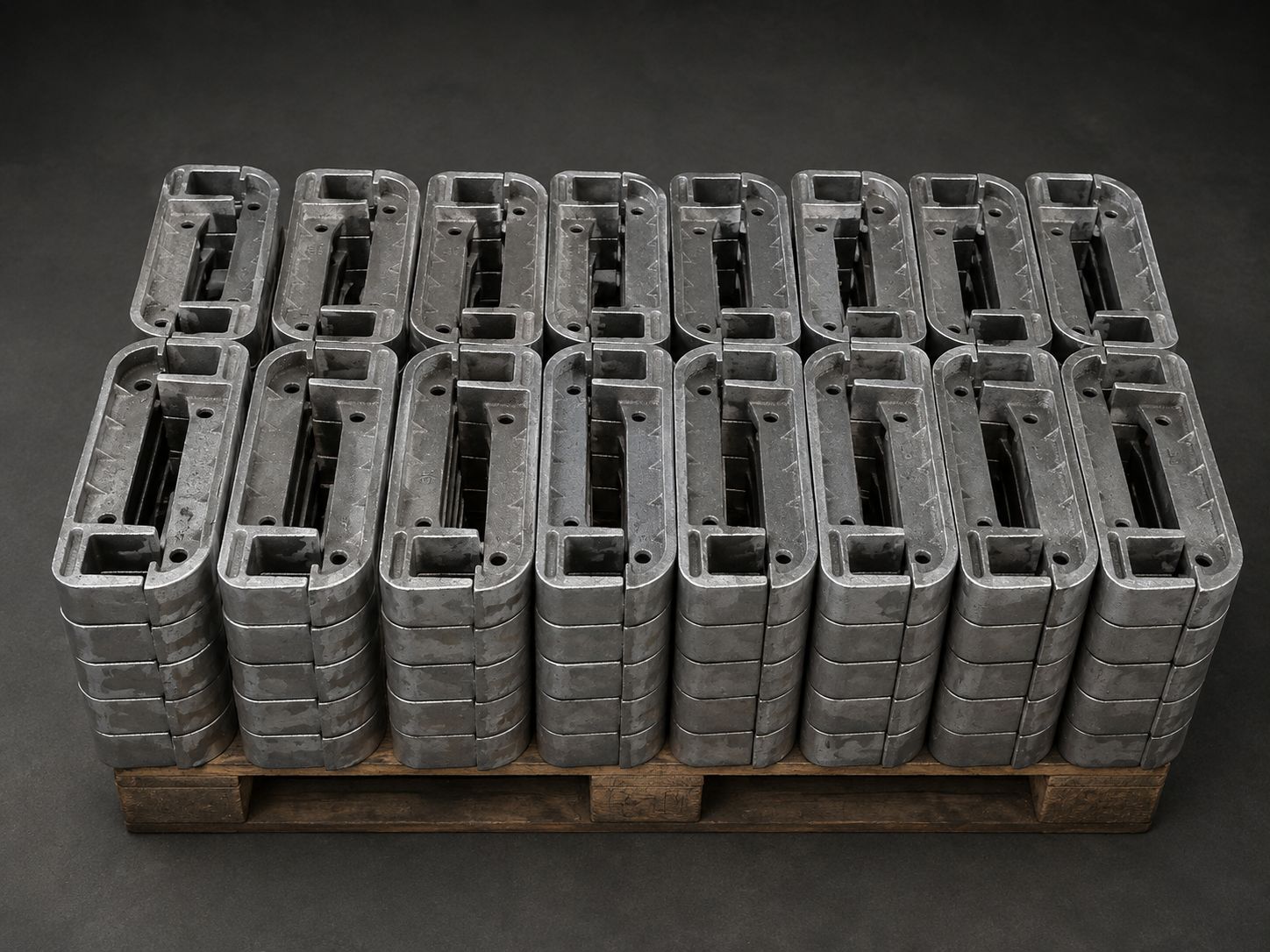



5D49 cylinder head for traction diesel engines


5D49 cylinder head for traction diesel engines
The production site that now operates as part of West Baltic Group accumulated experience in manufacturing 5D49 cylinder heads — critical parts of the main traction diesel engine for railway rolling stock.
The cylinder head works in one of the most heavily loaded diesel assemblies: it forms the upper part of the combustion chamber and carries the valve mechanism, injector assembly, cooling channels, threaded and seating elements. The part is simultaneously exposed to gas pressure, heat flow, vibration, cyclic loads and tightening forces.
Project features
- Water cavities and cooling channels formed by a core system are located inside the casting.
- The fire deck and bridges between valves operate at high temperature and pressure.
- After machining, areas are opened where hidden porosity or a defect immediately becomes a rejection criterion.
- The material must combine strength, stable microstructure, machinability and resistance to thermal cycles.
Technology
The part used spheroidal graphite cast iron of predominantly pearlitic structure, alloyed with copper, nickel and molybdenum. Graphite shape and distribution, spheroidization degree, pearlite content of the matrix, ferrite, carbides, cementite and phosphide eutectic were controlled.
The casting technology included a complex core system, organized venting, chills, calculated risers and management of directional solidification. At an early stage, 3D-printed sand cores were used, and casting processes were checked by filling, solidification and shrinkage-porosity risk simulations.
Production route
- Analysis of drawings, the product 3D model and the casting model.
- Development of cores, feeding, chills, venting and mould assembly.
- Transition from trial 3D-printed cores to pattern and core-box tooling.
- Machining on a four-axis machining centre with dozens of tools.
- Inspection of interdependent tolerances with special combined gauges.
Quality control
Each batch was accompanied by chemical composition analysis, mechanical testing, metallography, visual and dimensional inspection. After machining, plugs were installed, internal water cavities were pressure-tested, ultrasonic thickness measurement of the fire deck was performed, channels were inspected by borescope and passport documentation was prepared.
The result was not a one-off casting experiment, but an established manufacturing chain for a critical part: material, microstructure, mould, cores, tooling, machining, inspection, testing and repeat production. This project shows the team's ability to take on complex products where technical approach, process stability and responsibility for the finished part's service life are important.